Introduction


Introduction:

My name is Ella Budgett and my candidate number is 8120. The other two candidates I am with in Group 1 are Eleanor Lynch (8450) and Pru Carter-Phillips (8128). Our group photo can be seen on the right. To see my portfolio evidence, please click on the three labels on the right named A2 Research and Planning, A2 Construction, and A2 Evaluation.

MiraJax Best Be Believing Music Video

MiraJax Best Be Believing Music Video:

MiraJax- Best Be Believing

Front and Back Digipak

Front and Back Digipak

Inside Digipak

Inside Digipak
Inside Digipak


Please click this image to enter out site

Friday, 18 March 2016

Evaluation Question 1: In what ways does your media product use, develop or challenge forms and conventions of real media products?

Our film follows the life of a 17 year old girl called Lola, who experiences the negative affects of drug/alcohol abuse and how this leads the deterioration of friendships and family relationships. The main focus of our film is the breakdown of the connection with her boyfriend Marlon, and how her friends try to get her back on track.

Form

The typical features of an opening sequence are;

- introduces the main characters and gives a brief insight into their character traits
- presents a clear genre
- shows the film production and distribution companies in the titles
- sets up a narrative that will continue in the rest of the film

         
Hot Fuzz uses the typical features as it introduces the main character (using images and voice-over), presents the film as a crime and comedy, shows the production and distribution companies just after the title sequence and suggests that the narrative will be about Nicholas Angel's experiences as a police officer.

Our film opening follows this typical format as it introduces Lola and includes shots of her friendship group in the party as well as using titles throughout. It is obvious that the narrative will be based around Lola's life and captures key moments such as her hitting Marlon and a breakdown in the bathroom. Also, the montage party scene helps denote the indie teen drama genre that we were aiming for.

Genre

'Adolescents' mainly fits the typical conventions of an indie teen drama as we wanted to appeal to our target audience and so needed to focus on aspects that successful real media products have used. The main film that we looked at to gain a better understanding of our genre is 'Kidulthood' - this contains many negative stereotypes of teenagers as it pays close attention to the use of alcohol, drugs and violence. Following along with this theme, we also included these aspects of teenage lives in our opening yet portrayed them more subtly so that it didn't look obvious and forced.

USED CONVENTIONS

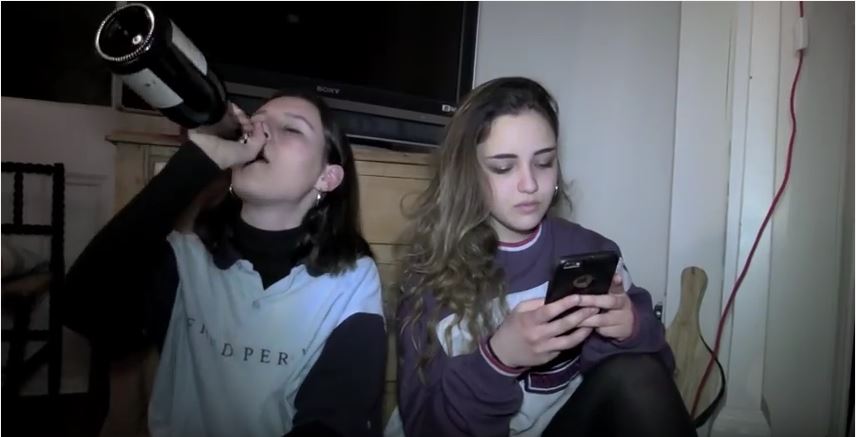
Lola is seen to be consuming alcohol whilst her friend is preoccupied with her phone (social media) which is a typical convention of teenagers - antisocial behaviour

In Kidulthood, the opening captures lots of school kids hanging around the playground in groups, with many of them absorbed by their phones


Narrative structure

In our film, the use of Todorov's narrative theory wasn't essential as we wanted our opening to be slightly ambiguous and be open for interpretation. The audience are left unaware as to who the closer friendships are between in the group and if there has been any previous conflict between Lola and Marlon (although they do find out as the story unravels). Our film doesn't follow the idea of an equilibrium being disturbed, setting in a chain of events which eventually leads to equilibrium again. Also, we didn't want to create audience gratification, so we ended our opening sequence with Lola pouring pills into the sink and breaking down. This creates a more disturbing anf unsettling feel which is true to real life, as nothing is left fully resolved. We did however, make use of Claude Levi-Strauss' binary opposites as the audience realises who Lola's 'good' friends are that want to help her, and who the 'bad' ones are that lead her to making  immoral decisions. This theory is often adopted by films even if it is unintentional as the idea of  'good' and 'bad' is unavoidable.

 
This is a prezi to show some of the narrative techniques we used in our sequence

Style

In order to create the British indie style that we wanted, we made specific use of music and pace. The soundtrack that we found on Soundcloud (Conducta - Felt This Way) has a strong beat is quite fast pace which helped to create the party atmosphere. It allowed for the dancing shots in the montage to fit in well and served as a diegetic sound during the party as it is what the characters would have been playing on the speakers. We used slow motion shots and real time shots in order to make the scene seem slightly distorted and this reflects the characters distorted sense of reality as they were drinking and consuming drugs.


Similarly, in Human Traffic, slo-mo is used to reflect a word of distorted reality, as well as using a voice-over to explain the characters feelings and emotions

Evaluation Question 2: How does your media product represent particular social groups?

The main social groups we wanted to represent are teenagers/students, with specific focus on gender roles. The overarching representation of teenagers in our film fits in with the negative portrayal that most real media products adopt, yet our closer inspection of gender roles challenges some of the norms of modern day society in order to make our product seem unique and bring new ideas to the film platform.

The negative view of teenagers today is that as a group, they cause trouble and pick up bad habits, such as smoking and drinking. - seen mainly as delinquents. This is then sown through the media TV dramas such as Skins and films such as Fish Tank.


This is a clip from our film that highlights the use of props such as smoking/rolling paraphernalia and alcohol bottles in order to suggest the negative stereotypes of teens. 

Gender Roles


In Kidulthood, the stereotypical gender roles have been adopted, with the dominating male gang intimidating the weaker, more vulnerable females.
Lola appears to be the violent and aggressive one towards Marlon and is physically violent as seen when she slaps him. This challenges typical conventions as in abusive relationships, it is normally the guy that is thought to be dangerous. We decided to do this in our film to appeal to males who feel targeted by stereotypical gender roles and to allow for them to not feel that they have to live up to the 'hyper-masculinity' that is so prominent in our society today.

Evaluation Question 3: What kind of media institution might distribute your media product and why?

Our chosen production company is Stealth Films and our chosen distribution company is StudioCanal.


To market our film, we would have to consider our target audience (teenagers in London) and how they would be informed about this new film. The main marketing strategies we would use are; a trailer, posters and creating social media accounts.

Trailer:

This would show the main characters in it and use a variety of London locations to make the film seem relatable and current. It could also include a soundtrack from a current urban artist such as Bugzy Malone. The trailer would be released in the evenings on TV as this is the time when most teenagers watch programmes, and would also be available to watch on YouTube as this is a popular website among most people.


Posters:

The posters would include the main characters of different ethnicities to reach out to everyone in our target audience and would use bold colours such as red to make it eye catching and appealing. These could be found on the sides of buses and dotted around London.


Social Media:

A Twitter and Facebook page would be made, with links to cinema websites where tickets can be bought to see the film, as well as links to interviews with cast members in order to give the audience a bit more insight into the film and make them more intrigued. Social media is major within the teenage community and people are able to share links and post about things, so our film awareness would spread quickly this way.


Our film would be released in different formats such as in the cinema, DVD, Blu-Ray and subscription sites like Netflix.


Evaluation Question 4: Who would be the audience for your media project?

Our core target audience is teenagers/students of both genders (ages 16-24) as the film deals with issue that people of these ages would be going through in their lives. Our secondary target audiences are fans of the British indie genre, domestic violence campaigns and possibly even schools.

The prezi below explains our audience in more detail.

Evaluation Question 5: How did you attract/address your audience?

In order to make our film compelling to our target audience, we use the Uses and Gratifications Theory which focuses on particular aspects that people gain from media.

We stuck to the conventions of British independent teen dramas:


  • Gritty and hard-hitting topics
  • Stereotypes of teenagers (mainly negative)
  • Used current music to help set the style/tone of the film
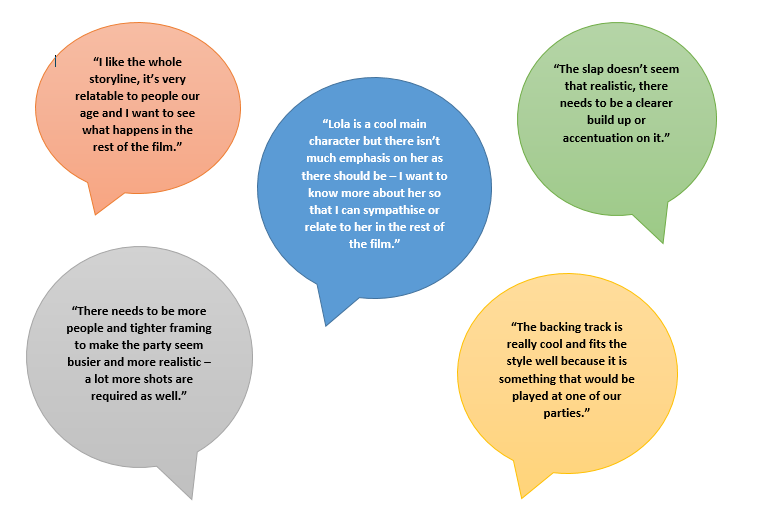
We wanted to get audience feedback from our target audience and media teachers to see if our film would be appealing. We got this feedback after our rough cut and then after our final product.


We took this on board when shooting and editing our final product, changing the parts that people didn't think worked well and keeping the parts that people liked.

To emphasise Lola's character and make it clear that she is the protagonist, we added a slow motion effect to the shots where it is just her - this makes her stand out.
We also added an effect when Lola walks in to see Marlon talking to another girl to make the build up the slap more obvious and exciting to the audience.
We made a graph to see what people thought of the final outcome and weather the changes we made had a positive impact on the feedback. We asked 10 people in our school year (year 12).


Our feedback at the end is clearly very positive and so we are happy with our ability to attract and address our audience,


Evaluation Question 6: What have you learnt about technologies from the process of constructing this project?

Before this project began I didn't know much about the different technologies that we have at our disposal, including both hardware (e.g. Canon Legria HRD30) and software (e.g. LiveType). After using these different types of technology, I am much more informed on how to shoot and edit a sequence to a high level.

Advantages of the hardware:
  • Equipment was easy to set up and very portable
  • Camera allowed us to watch back our shots to ensure we got the one we wanted
  • Controls on the camera were simple to use
  • Camera batteries were long-lasting and didn't need to be recharged
Disadvantages of the hardware:
  • Occasionally the lighting equipment would be in our shots as the lights are quite big and needed to placed in the main room so that the shots wouldn't be grainy
  • Lots of pieces (batteries, mic, tripod shoe, etc) that could get lost easily 


What I have learnt by Ella Budgett

Advantages of the software:
  • Premiere Pro had all the tools that we needed to use to edit our sequence, from basic cutting of shots to more complicated effects such as ghosting and grading
  • LiveType allowed for us to create inventive titles that suited our opening sequence
Disadvantages of the software:
  • LiveType only had a limited amount of title effects to choose from and had to be done on the Macbooks which took up space in the editing room
  • Premiere Pro takes some time to understand what all the tools do and how to apply them

Evaluation Question 7: Looking back at your preliminary task, what do you feel you have learnt in the progression from it to the full project?

Preliminary Task Brief:

Continuity task involving filming and editing a character opening a door, crossing a room and sitting down in a chair opposite another character, with whom she/he then exchanges a couple of lines of dialogue. The task should demonstrate match on action, shot/reverse shot and the 180-degree rule.


Prelim Continuity Video


Main Task:

The titles and opening of a new fiction film, to last a maximum of two minutes. All video and audio material must be original, produced by the candidate(s), with the exception of music or audio effects from a copyright-free source.

It is clear that there are some differences between the two briefs that we were given, a major one being that in the preliminary task we were set many things that had to be included, whereas in our main task, we had a lot more freedom to do what we wanted which I liked better as it allowed for creativity.

The prelim task first introduced me to the different hardware and software that we would be using in our main task and this enabled me to learn how to use these in advance so that I would be prepared and could contribute a lot in the main task.

In the main task we spent a lot more time on pre-production than in the prelim as we had more allocated media lessons and free time to do it. We made a timeline, a story board and a shotlist so that we knew exactly how we wanted things to run when getting our shots.

Our storyboard for the main task
Also, for production we only had a limited amount of space to shoot the prelim continuity sequence as it had to be shot in school during our media lessons and we could only use ourselves as characters so it was quite simple and restricted. But this gave us insight into the type of shots and angles that we could use when it came to our main task and improved our camera skills hugely. Our production for the main task was over a whole day and we had test shoot as well as a back up shoot to ensure we got the right shots. We also had a bigger space as it was shot in a house and many more extra characters.

This shows our opening shot, and clearly there is a big space and lots of characters

In post-production, we had more time to edit our main task than our prelim which allowed us to try out different effects in order to make our sequence better, but if we hadn't learned how to edit a continuity sequence in the prelim then we wouldn't have been able to experiment and produce a successful edit in our main task.

Conclusion:

The prelim was a very important starting point for this project as it taught us many things in pre-production, production and post-production, which enabled us to then go on to make a good opening sequence.